.webp)



Corruption and Drug Trafficking Fuel Each Other in Dangerous Global Cycle



.png )
COLOMBO (News 1st); The United Nations Office on Drugs and Crime (UNODC) has highlighted the inseparable link between corruption and organized crime, warning that criminal networks involved in drug trafficking and other illicit activities often seek to infiltrate public institutions, law enforcement agencies and judicial systems in order to protect and expand their operations.
The comments were made by Shervin Majlessi, Chief of the Corruption and Economic Crime Branch at UNODC, in response to a question from News 1st's Zulfick Farzan regarding the growing complexity of investigations into drug trafficking and corruption, particularly in cases where criminal activity is alleged to overlap with political and administrative structures.
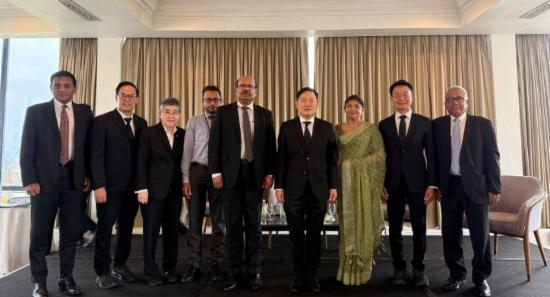
The discussion took place at the Korea-UNDP International Anti-Corruption Forum in Seoul.
While declining to comment on any specific country or ongoing investigation, Majlessi stressed that corruption and organized crime are closely interconnected and often reinforce one another.
"We see a clear link between corruption and organized crime, including drug trafficking. Corruption fuels organized crime, and organized crime fuels corruption," he said, emphasizing that authorities can no longer address the two issues separately.
The UNODC is the United Nations agency mandated to support member states in tackling drug trafficking, transnational organized crime, corruption and terrorism. It also serves as the guardian of the United Nations Convention against Corruption (UNCAC) and the United Nations Convention against Transnational Organized Crime (UNTOC), two of the key international legal frameworks used to strengthen anti-corruption and criminal justice systems worldwide.
Majlessi noted that there is increasing global recognition that corruption-related investigations must be approached alongside broader organized crime threats, including drug trafficking, human trafficking, migrant smuggling and environmental crimes.
He said recent discussions among state parties to the UN Convention Against Corruption have increasingly focused on developing practical recommendations and guidelines to help countries address situations where corruption and organized crime intersect.
According to Majlessi, criminal organizations frequently attempt to corrupt public officials and infiltrate institutions responsible for enforcing the law, making strong preventive measures and institutional safeguards essential.
"Organized crime and drug traffickers try to infiltrate the public sector, corrupt law enforcement and judicial authorities. There has to be a strong understanding of the risks and vulnerabilities within institutions, alongside effective responses," he said.
He further stressed the importance of maintaining the independence of law enforcement agencies, anti-corruption bodies and judicial institutions, noting that these safeguards are critical to protecting democratic governance and the rule of law.
The UNODC official added that the organization is increasingly focusing on integrated programmes that address both corruption and organized crime together, rather than treating them as isolated issues. Such an approach, he said, is becoming increasingly relevant for countries around the world as criminal networks become more sophisticated and expand across borders.
The United Nations Convention against Corruption itself recognizes the strong links between corruption, money laundering and organized crime, while calling for international cooperation, stronger institutions and enhanced asset recovery mechanisms to combat the growing threat posed by illicit financial flows and criminal enterprises.
Majlessi's remarks come amid growing international concern over the ways in which organized criminal groups use corruption to undermine governance, influence decision-making and shield illicit operations from detection, a challenge that anti-corruption and law enforcement authorities worldwide continue to confront.
Other Articles


-722285-845977_850x460-846337_550x300.jpg)







Featured News


-845392_550x300.png)

News 1st, MTV Channel (Pvt) Ltd, MBC Networks (Pvt) Ltd, 45/3, Braybrooke Street, Colombo-02.
T.P : +94 114 792 700,
Fax : +94 114 792 733
T.P : +94 114 792 700,
Fax : +94 114 792 733




 |  |  |
|---|---|---|
 |  |  |
 |  |  |
 |

.gif)