.webp)


When Water Becomes a Journey: Life in Sri Lanka's Thirst-Stricken Villages



.png )
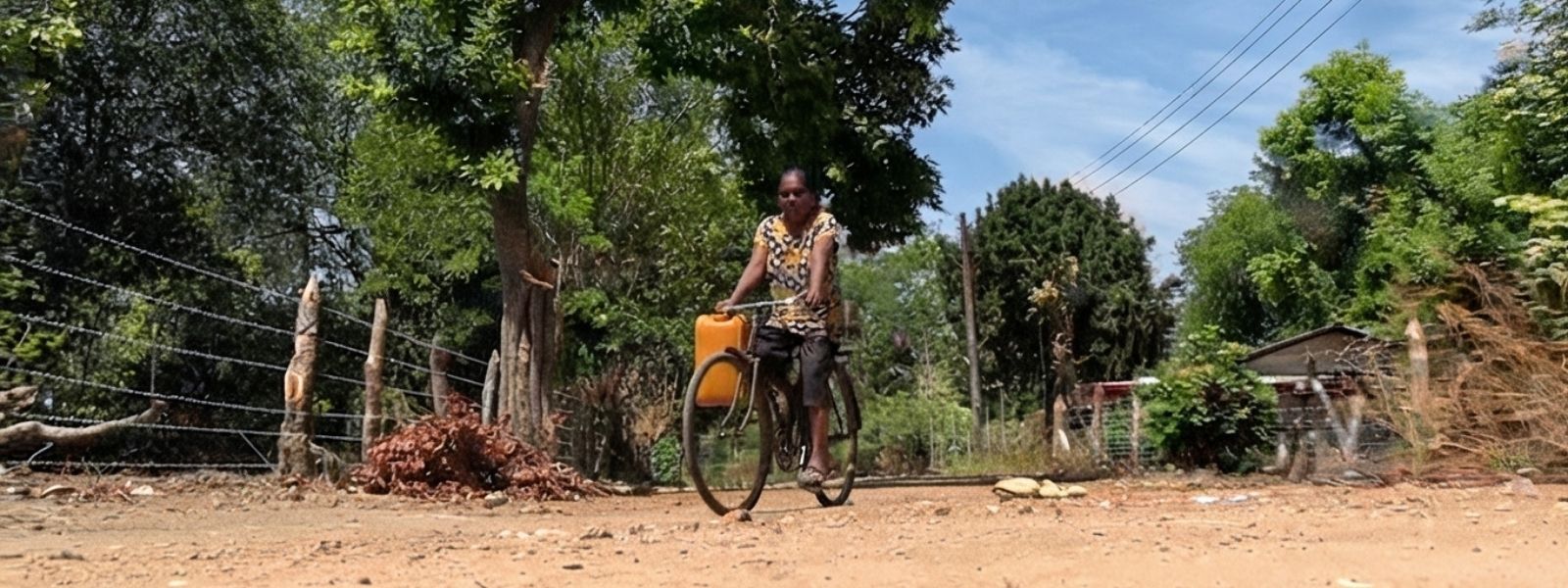
COLOMBO (News 1st): For many Sri Lankans, a glass of water is a routine part of daily life. For Nillmini, it has become the reason her day begins before sunrise and ends with another long journey.
In the drought-stricken village of Kolakanawadiya in Welikanda, Polonnaruwa, life is no longer organised around work, school or household chores. It is organised around water.
The taps no longer flow. The wells are disappearing. And every day, families leave their homes on bicycles and foot, travelling kilometres in search of enough water to get through another day.
"Water doesn't come through the tap lines anymore. We have to travel one or two kilometres by bicycle to fetch water. We have to do it every morning and evening," Nillmini said.
Her story is becoming increasingly common across several parts of the country as prolonged dry weather continues to strain drinking water supplies and place growing pressure on vulnerable communities.
In Kolakanawadiya, many traditional water sources have dried up completely. What was once a simple task has become a daily struggle.
Finding drinking water is not only difficult for Nillmini. It is a challenge shared by nearly every household in the village.
Residents now spend hours travelling long distances to collect water for drinking, cooking and basic sanitation.
The consequences are beginning to affect every aspect of daily life.
"How are we supposed to live? We don't even have enough water to use the toilet," one resident said.
Another woman described how even newly dug wells have failed to provide relief.
"Now even the well we dug has no water. We have to travel two or three kilometres to collect water. We don't have enough water to wash our pots and dishes properly. We gather everything together and wash them all at once because water is so scarce," she said.
As the drought deepens, authorities are preparing emergency measures to assist affected communities.
The National Water Supply and Drainage Board (NWSDB) says arrangements are being made to deploy water bowsers to areas experiencing severe shortages.
Sri Lanka currently produces approximately 2.8 million cubic metres of water per day, with around 24 percent sourced from major reservoirs and the remainder supplied through rivers and other water sources.
However, the country's water storage levels continue to reflect the impact of prolonged dry conditions.
Reservoirs managed by the Irrigation Department currently hold between 30 and 35 percent of their capacity, while reservoirs under the Mahaweli Development Authority maintain water levels between 50 and 55 percent.
Chairman of the National Water Supply and Drainage Board Chandana Bandara said the most significant impacts on the national water supply network are currently being experienced in Batticaloa and Monaragala districts.
He noted that severe water shortages are being reported in areas of Monaragala that are not covered by the Board's pipe-borne water supply system.
As an immediate response, the Board has begun restoring groundwater resources in the district.
"We have identified groundwater sources in Monaragala District and are currently cleaning and rehabilitating around 65 tube wells to bring them back to normal operational condition," Bandara said.
While communities in some districts grapple with water scarcity, officials maintain that the country's main water supply system remains stable.
The Western Province, which accounts for more than half of the National Water Supply and Drainage Board's total water consumption, has not been affected by the current dry spell.
Bandara said sufficient water remains available in all six major sources serving the province, including the Labugama and Kalatuwawa reservoirs, as well as the Kelani River, Kalu River, Attanagalu Oya and Ma Oya.
"There is no impact on the Western Province. All six sources currently contain adequate water reserves. The water stored in Labugama and Kalatuwawa alone is sufficient for approximately another three months," he said.
The shortage is also forcing authorities to think carefully about the months ahead, particularly as the next cultivation season approaches.
At a pre-season meeting held today, officials decided to commence Maha cultivation under the Kantale Irrigation Scheme from October 10.
Nearly 24,000 acres of paddy land have already been prepared for cultivation under the project.
Kantale Resident Project Manager P.G. Rathnasiri said water management would be critical to the success of the season.
"We have decided to complete crop establishment by November 5. Kantale is the final reservoir in the Mahaweli system and water has to travel more than 50 kilometres to reach it. Our primary objective is to manage available water efficiently and ensure a successful cultivation season," he said.
For policymakers and water managers, the figures tell one story. For villagers like Nillmini, the reality is measured in bicycle rides, empty containers and dust-covered roads.
As Sri Lanka waits for rain, thousands of families continue to do what they have done for months: wake up each morning and set off in search of the one resource that has suddenly become the most precious of all.
Other Articles






Featured News


-849213_550x300.jpg)

News 1st, MTV Channel (Pvt) Ltd, MBC Networks (Pvt) Ltd, 45/3, Braybrooke Street, Colombo-02.
T.P : +94 114 792 700,
Fax : +94 114 792 733
T.P : +94 114 792 700,
Fax : +94 114 792 733




 |  |  |
|---|---|---|
 |  |  |
 |  |  |
 |

.gif)