.webp)


'Pretty Satisfying' Results Says IMF on Sri Lanka's Path



.png )
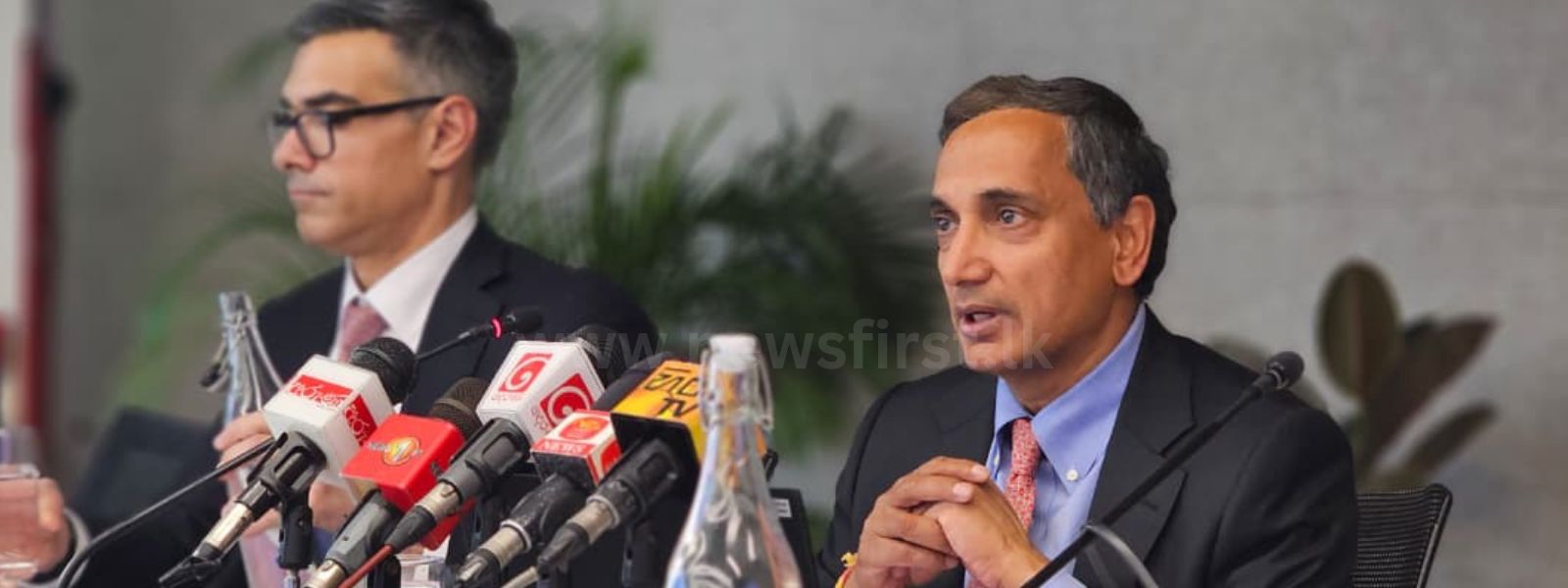
COLOMBO (News 1st); Dr. Krishna Srinivasan, Director of the International Monetary Fund's Asia and Pacific Department, outlined the key pillars of the IMF-supported program for Sri Lanka and highlighted its progress to date, during an interaction with journalists in Colombo on Wednesday (28).
The program rests on five main pillars. The first focuses on revenue-based fiscal consolidation, paired with institutional fiscal reforms and strengthening social safety nets. Srinivasan emphasized that the program includes a minimum spending floor on social safety nets, meaning the government must spend at least that amount but can allocate more to support vulnerable populations.
The second pillar aims to restore debt sustainability through fiscal consolidation and debt restructuring. The third targets restoring price stability while rebuilding external buffers, such as foreign reserves. The fourth pillar safeguards financial stability. Finally, the fifth pillar seeks to improve governance and reduce corruption.
Srinivasan described the country's performance under the program as "pretty gratifying" and "pretty satisfying" in many respects. From the depths of the crisis, economic growth has picked up sharply, reaching 5 percent last year. Tax revenue as a share of GDP has more than doubled, rising from 7.3 percent at the crisis's peak—about six months ago—to 14.8 percent today. This increase anchors fiscal efforts, reflecting actions by the government and the people of Sri Lanka.
Inflation has also improved dramatically. Srinivasan recalled that during his first press conference on the matter two or three years ago, inflation stood at 70 percent. Now, it ranges from 2 to 3 percent and is expected to rise toward the central bank's 5 percent target.
Overall, Srinivasan said the program has successfully delivered on objectives like growth, price stability, building external buffers, and improving governance while reducing corruption. He noted, however, that a long way remains ahead to fully address outstanding needs.
Other Articles

-824954_550x300.jpg)








Featured News

-822734_550x300.jpg)
-822716_550x300.jpg)
-822495_550x300.jpg)
-819380_550x300.jpg)
News 1st, MTV Channel (Pvt) Ltd, MBC Networks (Pvt) Ltd, 45/3, Braybrooke Street, Colombo-02.
T.P : +94 114 792 700,
Fax : +94 114 792 733
T.P : +94 114 792 700,
Fax : +94 114 792 733




 |  |  |
|---|---|---|
 |  |  |
 |  |  |
 |

.gif)