


Could Nuclear Energy Help Solve Sri Lanka's Power Needs?



.png )
COLOMBO (News 1st); As nations around the world race to secure cleaner and more reliable sources of energy, Sri Lanka is taking a closer look at a technology that could fundamentally reshape its electricity future: nuclear power.
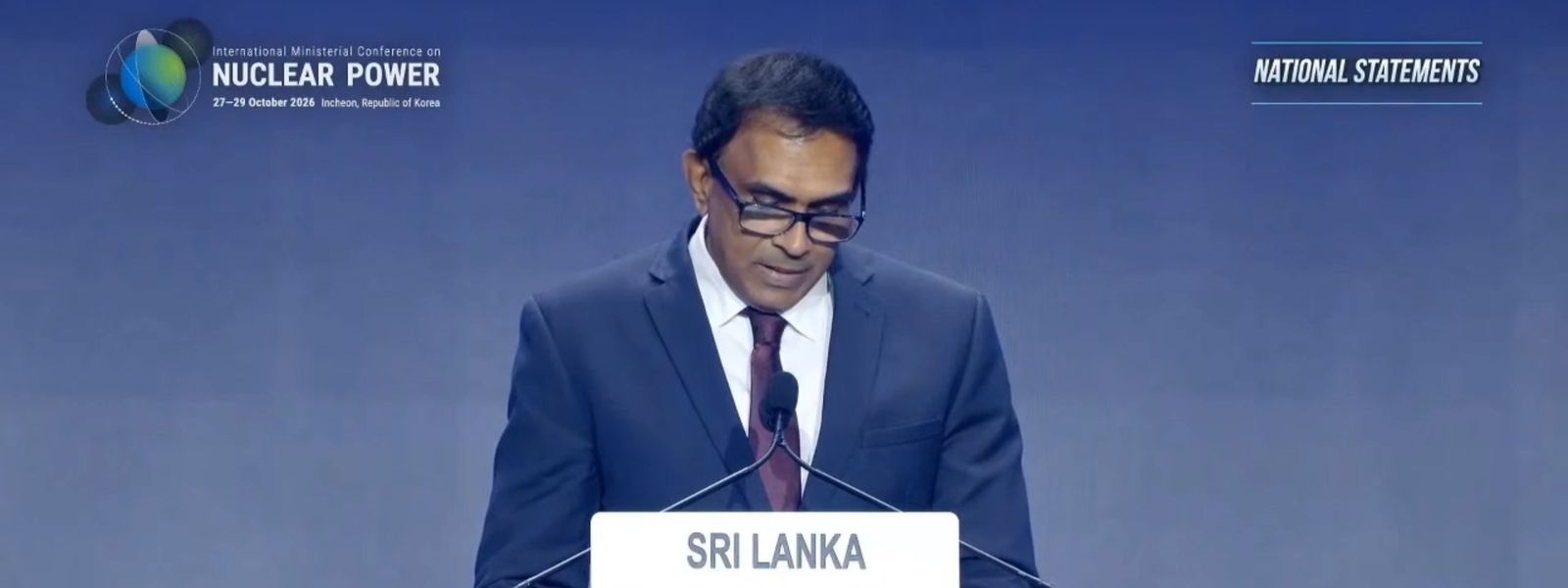
Speaking on the country's long-term energy strategy in South Korea, Minister of Science and Technology Prof. Chrishantha Abeysena said Sri Lanka is carefully evaluating whether nuclear energy could play a role in meeting future electricity demand while supporting climate commitments and reducing dependence on conventional energy sources.
According to the Minister, Sri Lanka remains committed to building an electricity system that is secure, reliable, affordable and sustainable. Within that broader vision, nuclear energy has emerged as one of several options being studied for the decades ahead.
"Nuclear power is included in the base case of the Sri Lanka Electricity Board's Least-Cost Long-Term Generation Expansion Plan 2025-2044. However, this is not a final national decision to proceed."
Prof. Abeysena emphasized that Sri Lanka has not yet decided to introduce nuclear power and is currently following the International Atomic Energy Agency (IAEA)'s milestone approach to evaluate whether such a programme is suitable for the country.
"Sri Lanka is in the final stage of Phase One, assessing whether nuclear power is appropriate for our country. Our priority is to address outstanding infrastructure issues and provide the government with a sound basis for an informed decision."
The Minister noted that even if a decision is eventually taken to move forward, significant groundwork would still be required before any nuclear power project could become a reality.
"Further work would be needed on site selection, reactor technology, grid integration, financing, regulation and institutional capacity."
He stressed that safety would remain non-negotiable throughout the decision-making process.
"Safety, security and safeguards will remain fundamental. We recognise the importance of effective regulation, emergency preparedness, radioactive waste management and sustainable financing."
Sri Lanka is also preparing for the possibility of developing the highly skilled workforce that would be required to support a future nuclear programme.
At the same time, the country is closely monitoring emerging technologies, including small modular reactors, which are attracting global attention as a potentially more flexible and scalable form of nuclear power generation.
"Given our relatively small electricity grid, grid stability, operational flexibility and investment requirements will be important considerations when assessing suitable options. Our approach will remain technology-neutral and evidence-based."
Prof. Abeysena highlighted the crucial role played by international cooperation, particularly the support provided by the IAEA through technical assistance programmes and infrastructure review missions.
"We greatly appreciate the IAEA's support through its International Nuclear Infrastructure Review missions, follow-up activities and technical cooperation programmes."
He said Sri Lanka intends to continue working closely with international partners as it evaluates technology options, strengthens regulatory frameworks and builds national expertise.
Ultimately, the Minister said the country's objective is not to pursue nuclear power for its own sake, but to determine whether it can deliver measurable benefits to the nation.
"Our objective is not simply to introduce nuclear power but to determine whether it can deliver clear national benefits and contribute to a secure, reliable, affordable and low-carbon electricity system."
In perhaps his strongest statement on the issue, Prof. Abeysena made clear that the final decision will be guided by evidence rather than politics or ideology.
"If our assessment establishes a compelling case, Sri Lanka will consider moving forward responsibly and in accordance with international standards. If it does not, that conclusion must be respected."
As Sri Lanka looks toward a future shaped by rising energy demand, climate challenges and the need for greater energy security, nuclear power remains a possibility rather than a promise. For now, the country's message is clear: every option is on the table, but only the evidence will decide what comes next.
Other Articles
-860732_550x300.jpg)
-860726_550x300.jpg)
-860720_550x300.jpg)

-860708_550x300.jpg)
-860702_550x300.jpg)




Featured News




News 1st, MTV Channel (Pvt) Ltd, MBC Networks (Pvt) Ltd, 45/3, Braybrooke Street, Colombo-02.
T.P : +94 114 792 700,
Fax : +94 114 792 733
T.P : +94 114 792 700,
Fax : +94 114 792 733




 |  |  |
|---|---|---|
 |  |  |
 |  |  |
 |

