.webp)


Sun Directly Over Sri Lanka | Authorities Warn of Rising Heat and Worsening Drought



.png )
COLOMBO (News 1st): Sri Lanka's battle with prolonged dry weather intensified as authorities warned of rising heat levels, shrinking water resources and the growing impact of El Niño conditions that have already affected more than 84,000 people across the country.
The Department of Meteorology announced that from today until September 7, the sun will be positioned directly overhead across various parts of Sri Lanka, a phenomenon that occurs twice annually as the apparent movement of the sun passes over the island.
Director of Forecasting at the Department of Meteorology, Meril Mendis, said that at 12:11 p.m. today, the sun would be directly overhead in Kokkuvil, Nallur, Kodikamam and Nagar Kovil in the Northern Province.
The announcement comes amid mounting concerns over soaring temperatures and persistent drought conditions in several regions.
Meteorologists warned that the heat index, which measures the temperature felt by the human body, remains at a level requiring attention in eight districts, namely Trincomalee, Ampara, Batticaloa, Polonnaruwa, Mullaitivu, Kilinochchi, Monaragala and Jaffna.
Authorities urged residents in these areas to take precautions against prolonged exposure to heat, remain hydrated and pay particular attention to vulnerable groups including children, the elderly and those engaged in outdoor work.
The heat advisory was further extended to the Eastern Province and parts of Polonnaruwa, Jaffna, Kilinochchi, Mullaitivu, Vavuniya and Monaragala, where temperatures continue to remain elevated.
Meanwhile, the Disaster Management Centre (DMC) says the ongoing El Niño conditions have affected 84,545 people across seven districts, with Monaragala emerging as the worst-hit district.
According to the DMC, 35,639 people in Monaragala have been affected by the dry weather, while 28,523 people in Batticaloa and 8,847 people in Ampara are also experiencing difficulties due to prolonged drought conditions.
In addition, residents in several Divisional Secretariat divisions in Badulla, Polonnaruwa, Hambantota and Ratnapura are facing growing water shortages as water sources continue to dry up.
The DMC stated that emergency measures have already been implemented to provide drinking water to 75,734 affected individuals, highlighting the increasing pressure being placed on water resources across the country.
One of the clearest indicators of the severity of the drought can be seen at the Kantale Reservoir in Trincomalee District.
Irrigation Engineer S.A.D. Wasantha Kumara revealed that the water level of the reservoir has fallen to 30.2 percent capacity due to the prevailing El Niño conditions.
According to officials, catchment areas feeding the reservoir have dried up significantly, while the natural water sources supplying the reservoir have virtually ceased flowing.
The situation is particularly concerning given that the Kantale Reservoir serves as a vital source of drinking water for Kantale, Thambalagamuw, Trincomalee, Kinniya and Muttur, placing thousands of residents at risk should water levels continue to decline.
Elsewhere, the drought is increasingly affecting the North Central Province, where several small tanks in the Anuradhapura District are experiencing rapidly declining water levels.
Among the reservoirs reporting reduced water storage are Doramadalawa Wewa, Ukkulankulam Upper Tank and Pudukkulam Wewa.
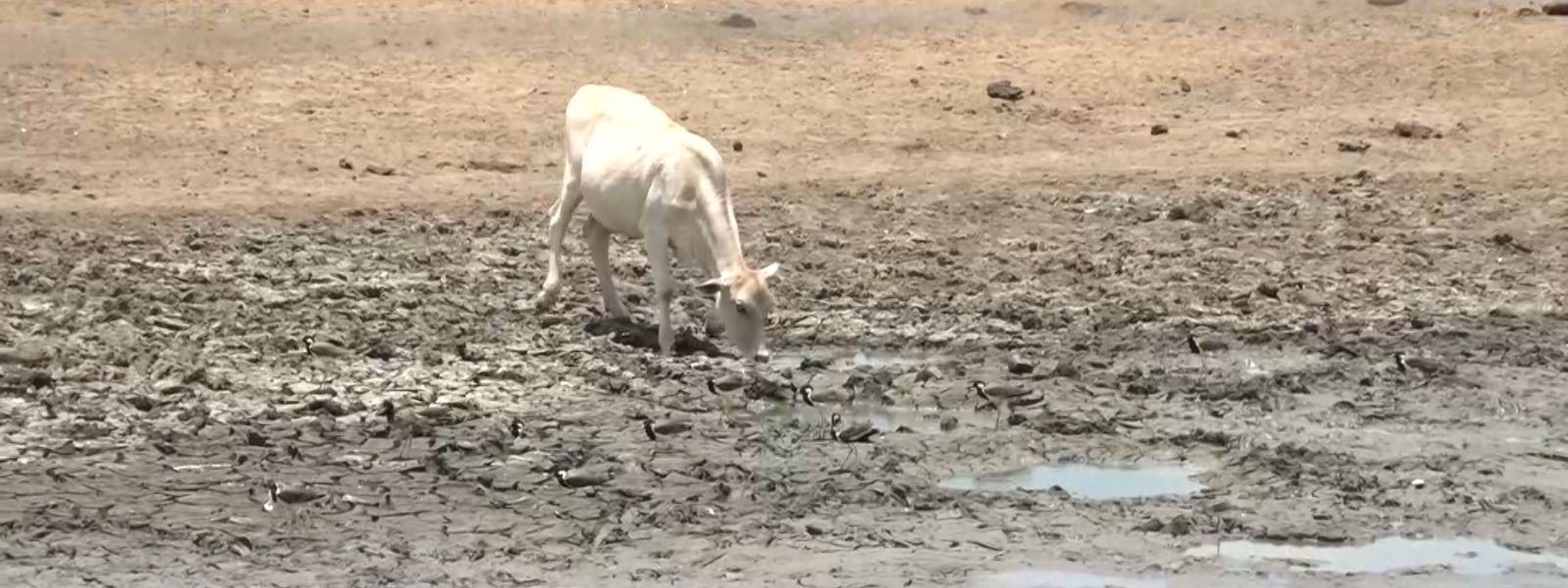
Residents who depend on agriculture and dairy farming for their livelihoods say the situation is becoming increasingly challenging as water sources continue to shrink.
The impact is particularly visible in the Vilachchiya area, where major reservoirs including Kuda Oyamaduwa Wewa and Maningamuwa Wewa, along with several smaller tanks, have either dried up completely or reached critically low levels.
Scenes from affected areas show cattle roaming long distances in search of water, highlighting the growing pressure on livestock farming.
Dairy farmers in Anuradhapura say the lack of water and fodder is placing significant strain on their businesses, with some struggling to meet even basic operational costs.
The drought is also beginning to affect wetland ecosystems.
In Ampara District, water levels in the Korakallapu Lagoon have also been declining steadily amid the prolonged dry spell, raising concerns among local communities that depend on the lagoon and surrounding ecosystems.
The developing situation highlights the increasingly severe impact of El Niño across Sri Lanka, where a combination of extreme heat, dwindling water supplies and stressed agricultural systems is affecting both livelihoods and daily life.
Other Articles


-852821_550x300.jpg)






Featured News


-849213_550x300.jpg)
News 1st, MTV Channel (Pvt) Ltd, MBC Networks (Pvt) Ltd, 45/3, Braybrooke Street, Colombo-02.
T.P : +94 114 792 700,
Fax : +94 114 792 733
T.P : +94 114 792 700,
Fax : +94 114 792 733




 |  |  |
|---|---|---|
 |  |  |
 |  |  |
 |

.gif)