.webp)


'Threat', 'Thereat' or What? | How Many Explanations Can One Official Letter Have?



.png )
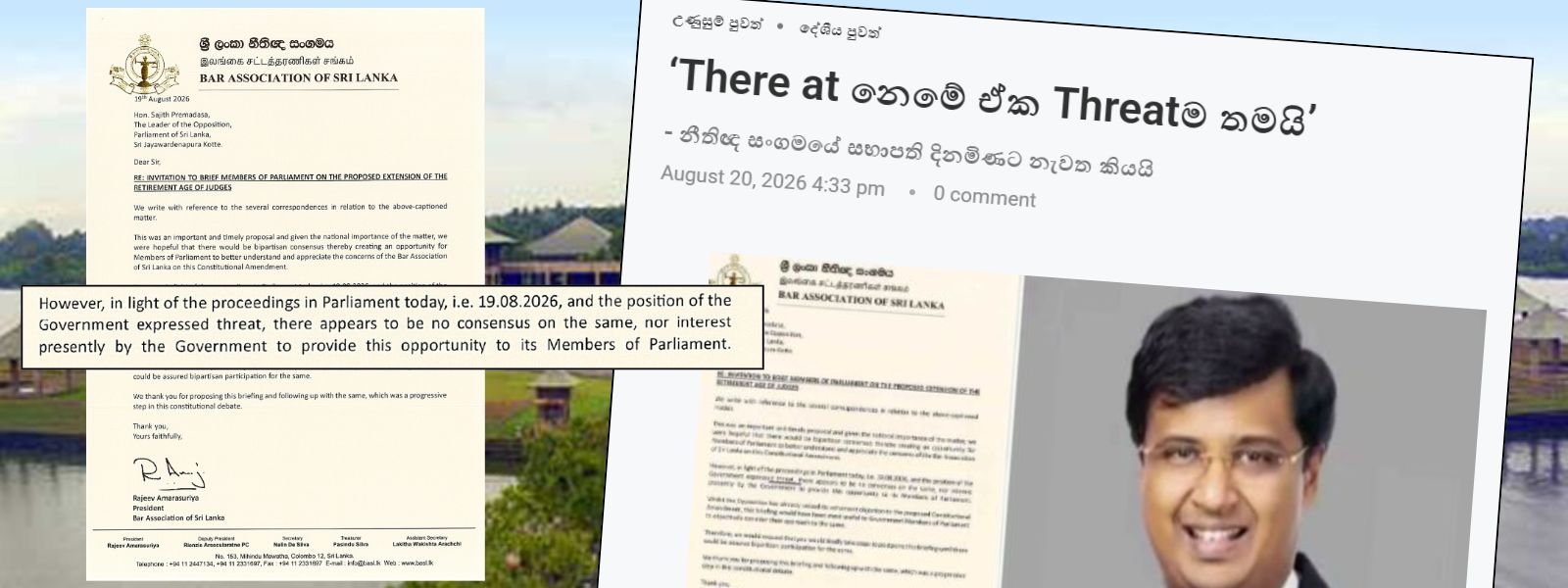
COLOMBO (News 1st); A question has now emerged over the manner in which an official letter issued by the Bar Association of Sri Lanka (BASL) was prepared and communicated after a series of contradictory explanations were given regarding one of its most controversial references.
The issue originates from a letter sent by BASL President Rajeev Amarasuriya to Opposition Leader Sajith Premadasa following the parliamentary debate surrounding a proposed briefing for Members of Parliament. The correspondence contained a reference that was widely interpreted as stating that the Government had adopted a threatening position.
However, over the course of a single afternoon, a number of differing explanations were provided about the wording used in the letter.
When News 1st contacted BASL President Rajeev Amarasuriya at 1.10 p.m., his response was:
"Take the contents of the letter. Call later for further details."
Later, at 2.06 p.m., News 1st sought clarification from BASL Secretary Nalin De Silva. His response was:
"The letter does not refer to any threatening statement made by the Government."
The matter took another turn at 3.33 p.m., when Dinamina reported that Rajeev Amarasuriya had indicated that the disputed wording could have been "there at" rather than "threat."
Following that report, News 1st once again contacted BASL Secretary Nalin De Silva at 4.09 p.m. seeking further clarification.
At that stage, the BASL Secretary stated that:
"'Threat' is the correct word. Rajeev told Dinamina to correct it."
Shortly afterwards, at 4.33 p.m., Dinamina reported that Rajeev Amarasuriya had telephoned the newspaper again and clarified that the wording was not "there at", but in fact "threat", meaning a threat.
The sequence of events has drawn attention because the document in question was not an informal communication or a draft note.
It was an official letter sent under the signature of the President of the Bar Association of Sri Lanka to the Leader of the Opposition regarding a matter connected to a significant constitutional issue.
Should the President of one of the country's leading professional bodies be sending letters on a matter as important as a constitutional amendment without being able to provide a clear and definitive explanation of its contents?
_page-0001.jpg)
Other Articles









Featured News


-849213_550x300.jpg)

News 1st, MTV Channel (Pvt) Ltd, MBC Networks (Pvt) Ltd, 45/3, Braybrooke Street, Colombo-02.
T.P : +94 114 792 700,
Fax : +94 114 792 733
T.P : +94 114 792 700,
Fax : +94 114 792 733




 |  |  |
|---|---|---|
 |  |  |
 |  |  |
 |

.gif)