.webp)


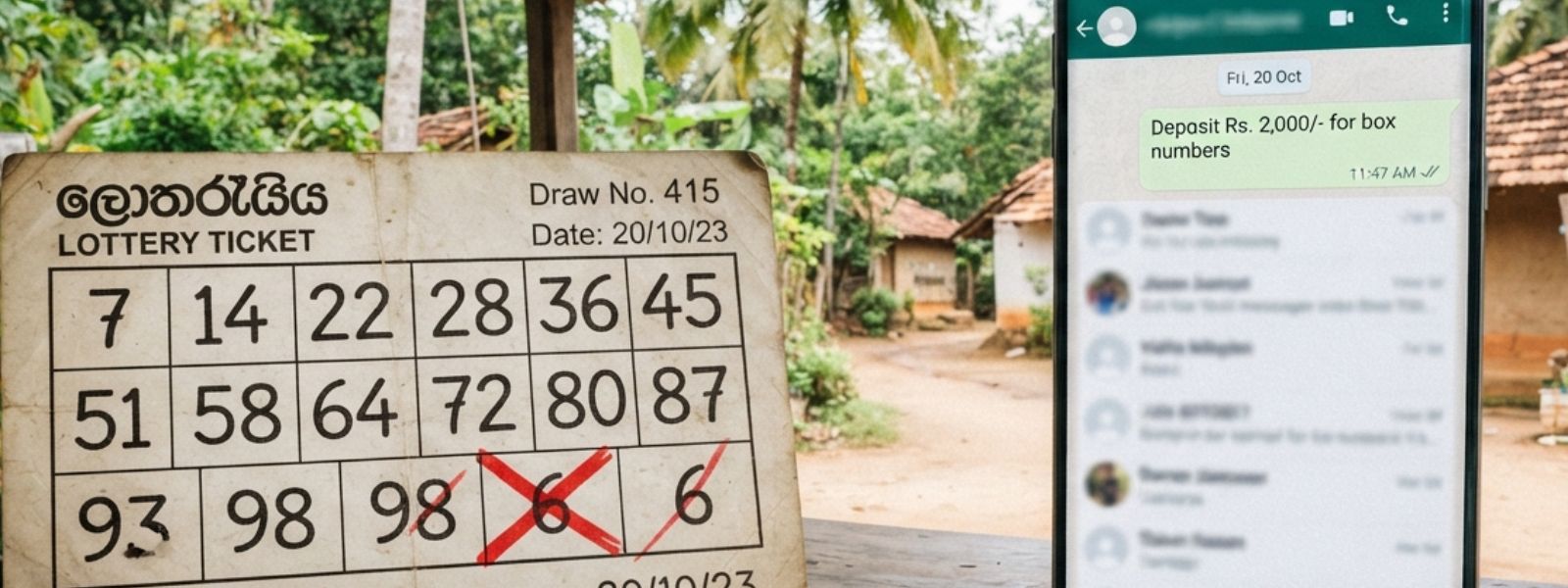
A Simple Lottery Number Has Become a Dangerous Addiction for Thousands



.png )
COLOMBO (News 1st); What begins as a small wager on a pair of numbers can end with a family losing its savings, its property and, in some cases, its future.
That was the alarming picture painted before the Committee on Public Enterprises (COPE) Subcommittee this week, where officials from the National Lotteries Board revealed the scale of an illegal gambling operation that has quietly spread across Sri Lanka by exploiting the winning numbers of state lottery draws.
According to National Lotteries Board Chairman Cyril Anthony Perera, the activity, commonly known as "number cross cutting" or "box cutting", has evolved from a small-scale village betting practice into what he described as one of the country's most serious social problems.
Appearing before the COPE Subcommittee, Perera warned that the illegal gambling network is now causing widespread economic and social damage, with some gamblers in high-income areas wagering as much as Rs. 100,000 on a single number combination.
The issue arose during discussions on the Board's efforts to combat illegal lottery-related activities. Auditor General officials noted that legislative reforms had already been identified as a necessary step in addressing the problem and inquired about progress.
In response, National Lotteries Board officials stated that Cabinet approval has already been secured for amendments to the relevant law. A draft prepared by the Legal Draftsman's Department has been received, and the Board's observations have subsequently been forwarded to the relevant ministry.
The discussion intensified when COPE Subcommittee Chairman MP Dinesh Hemantha raised concerns about the increasingly widespread practice known as "number cross cutting" or "box cutting".
Perera did not downplay the scale of the problem. He told the committee that the illegal operation has now become a major social scourge and is surpassed only by the narcotics menace in terms of its impact on communities.
What makes the scheme particularly concerning is its simplicity.
Gamblers place bets on combinations of numbers based on the final digits of official lottery draws conducted by the National Lotteries Board and the Development Lotteries Board. Organisers use unofficial networks to collect bets, often promising insider knowledge of upcoming results.
Years ago, such wagering was limited to small bets of around Rs. 100 in rural communities. Today, according to Perera, the amounts involved have multiplied dramatically.
In areas with higher disposable incomes, individual bets can exceed Rs. 100,000.
The system has also moved beyond face-to-face betting.
Perera said fraudsters are now using WhatsApp groups and other digital platforms to lure victims by claiming they have advance access to winning numbers. Some operators reportedly tell participants that they already know the final two digits of a lottery draw and demand payments of around Rs. 2,000 for the information.
The deception does not end there.
According to the National Lotteries Board Chairman, some of these groups falsely claim that official lottery draws are predetermined months in advance and that winning numbers are being released gradually to select individuals. These claims, he said, are being used to target vulnerable communities and extract even larger sums of money.
The gambling trend appears to have spread deeply into several regions of the country.
Perera said a wager may be worth around Rs. 100 in some areas, but in places such as Manampitiya the value increases significantly during paddy harvesting seasons, sometimes reaching Rs. 30,000 per bet. In gem-rich regions such as Ratnapura, the figures are even higher, often surpassing Rs. 100,000.
He warned that communities in areas including Badalkumbura and parts of the Eastern Province have become heavily exposed to the practice.
The consequences, according to the Board, are becoming increasingly visible.
Perera told lawmakers that many individuals have lost substantial amounts of money, while others have reportedly sold assets and fallen into severe financial distress. Some families, he said, have been pushed to the brink.
In one striking example, he revealed that women frequently contact the Board to complain about the impact on their households.
"Some wives tell us that their husbands no longer even spend money on their usual evening habits. Every rupee is going into gambling instead," he said, highlighting the grip the activity has gained over some participants.
Despite recognising the severity of the problem, authorities face legal obstacles in tackling it.
Perera explained that the National Lotteries Board can take legal action under existing legislation only when official lottery products are directly imitated or manipulated. However, the current illegal betting model operates in a legal grey area that is not adequately covered by the available laws.
As a result, discussions have already taken place with government ministers, officials of the Ministry of Finance and legal authorities regarding possible legislative reforms.
The National Lotteries Board has also lodged complaints with law enforcement agencies, including criminal investigation authorities, in an effort to curb the growing operation.
Perera stressed that the activity cannot be legalised, incorporated into official lottery operations or ignored.
Instead, he called for urgent legislative intervention and stronger enforcement measures before the problem becomes even more widespread.
His warning was stark.
If decisive action is not taken, he said, the damage will extend beyond the lives of individual gamblers and their families. The continued expansion of these illegal betting networks could eventually undermine the operations of both the National Lotteries Board and the Development Lotteries Board while leaving behind a trail of financial ruin and social hardship across the country.
For many Sri Lankans, what appears to be a harmless gamble on a pair of numbers may, in reality, be the first step into a growing underground industry that authorities now fear is spiralling into a national crisis.
Other Articles
-850726_550x300.jpg)



-850678_550x300.jpg)




Featured News


-849213_550x300.jpg)
-848028_550x300.jpg)
News 1st, MTV Channel (Pvt) Ltd, MBC Networks (Pvt) Ltd, 45/3, Braybrooke Street, Colombo-02.
T.P : +94 114 792 700,
Fax : +94 114 792 733
T.P : +94 114 792 700,
Fax : +94 114 792 733




 |  |  |
|---|---|---|
 |  |  |
 |  |  |
 |

.gif)