.webp)


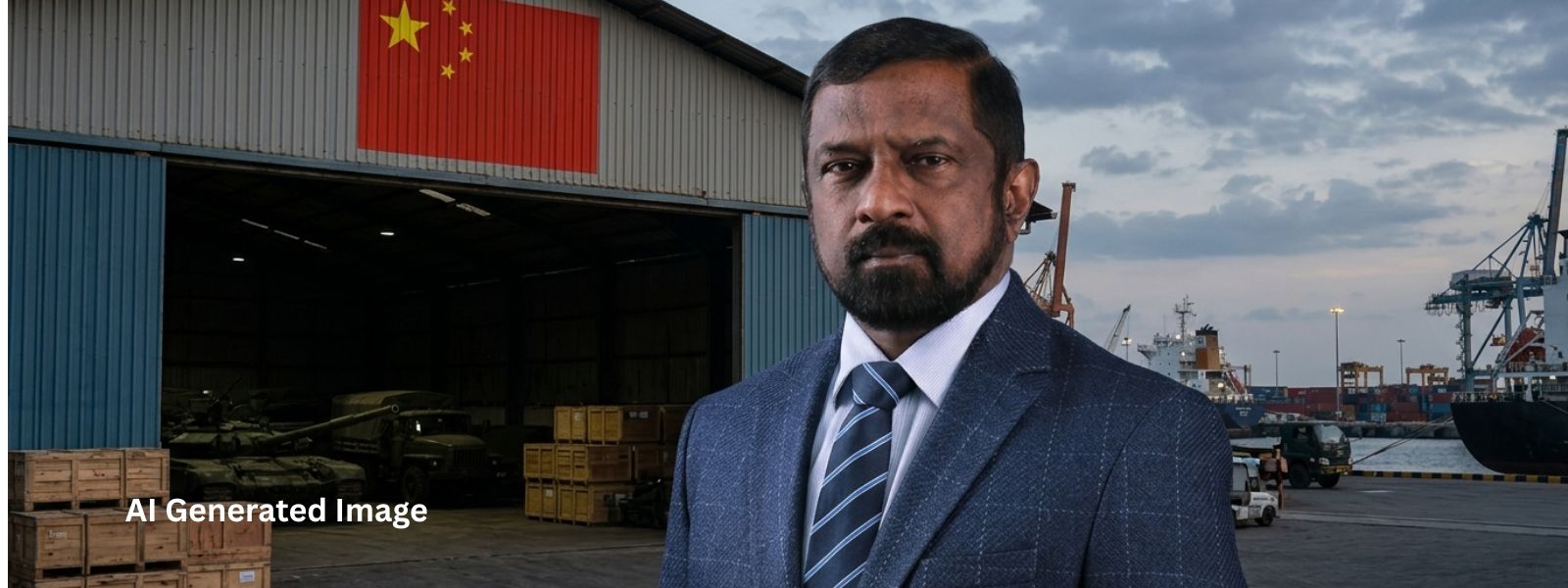
'Weapons Supermarket' : Inside China's Wartime Bonded Warehouses in Sri Lanka



.png )
COLOMBO (News 1st); China’s establishment of bonded warehouses in Sri Lanka during the final phase of the conflict enabled immediate access to military supplies and played a decisive role in the country’s war effort, according to Admiral (Prof) Jayanath Colombage, former Commander of the Sri Lanka Navy.
Speaking on China’s involvement, Colombage said Beijing went to the extent of setting up bonded warehouses at the ports of Colombo and Galle during the critical 2006–2009 period.
“That meant we could go there with a letter of authorisation from the Ministry of Defence. It was like carrying a shopping list, going to a weapons supermarket. You collect what you want, use it, and pay later,” he said.
He noted that these warehouses were stocked with a wide range of military supplies brought in advance by China, allowing Sri Lanka to immediately obtain what was required for operations.
“I don’t know whether any other country has done something like this in another country, but they brought all the items to the warehouse and we went and collected them,” he said.
Colombage emphasised that China’s military support became crucial in the final years of the conflict, describing it as “paramount” in achieving victory in what he referred to as the 30-year war.
He explained that while Sri Lanka received support from several countries including India, the United States, Iran, Russia, Ukraine and Pakistan, there were significant constraints.
Some countries imposed restrictions on providing lethal weapons, limiting assistance to training or non-lethal support, while others placed embargoes that restricted access to arms or ammunition.
“In some cases, we could buy weapons but not ammunition. In others, we were given platforms such as warships without weapons,” he said.
In contrast, Colombage said China provided comprehensive military support, including arms, ammunition, artillery, mortars, radars, armoured vehicles, battle tanks, aircraft and naval vessels, making it Sri Lanka’s main defence supplier during the 2006–2009 period. He added that Chinese military cooperation with Sri Lanka dates back to as early as 1971, but became particularly significant in those final years of the war.
He also placed China’s involvement within the context of its broader strategic expansion.
“Around 2005 to 2009, China began focusing beyond the South China Sea and East China Sea, especially into the Indian Ocean. Sri Lanka became a key focus due to our geo-strategic location,” he said.
He pointed out that Sri Lanka lies just 12 nautical miles from one of the world’s busiest east-west shipping routes, with nearly 300 ships passing daily, highlighting the island’s strategic importance.
Colombage further noted that Sri Lanka has maintained peace since the end of the conflict, adding that, as mentioned by the President, no lives had been lost due to the war after May 19, 2009.
Turning to the post-war period, he explained how China quickly transitioned into Sri Lanka’s main development partner.
At the end of the conflict, he said, Sri Lanka lacked major infrastructure, including highways. He pointed to key developments that followed, including the completion of the Southern Expressway in 2011, the Norochcholai Power Plant in 2011, the Colombo International Container Terminal in 2011, the Katunayake-Colombo Expressway in 2013, and Mattala Airport in 2013.
Colombage attributed China’s rapid role in infrastructure development to the presence of Chinese companies already operating in Sri Lanka during the war.
“All those companies that were in Colombo providing weapons instantly became construction companies,” he said.
He added that many Chinese enterprises are state-owned and operate based on directives from the central government, enabling them to shift quickly from defence-related activities to large-scale development projects.
“This gave them a huge advantage. They were already here, with offices and operations in place,” he said.
Colombage also highlighted the absence of Western investment in the immediate post-conflict period.
“There was a vacuum, and our needs were very high. That vacuum created in Sri Lanka after the conflict, with no one coming forward to support, was immediately filled by China,” he said.
He pointed out that China’s role during and after the conflict demonstrated a combination of military and economic engagement that significantly shaped Sri Lanka’s trajectory in both wartime and post-war development.
Other Articles
-839913_550x300.jpg)
-839900_550x300.jpg)
-839894_550x300.jpg)

-839882_550x300.jpg)




Featured News
-835300_550x300.jpg)

News 1st, MTV Channel (Pvt) Ltd, MBC Networks (Pvt) Ltd, 45/3, Braybrooke Street, Colombo-02.
T.P : +94 114 792 700,
Fax : +94 114 792 733
T.P : +94 114 792 700,
Fax : +94 114 792 733




 |  |  |
|---|---|---|
 |  |  |
 |  |  |
 |

.gif)