


Every School to Be Mapped Under Islandwide Education Reform Drive



.png )
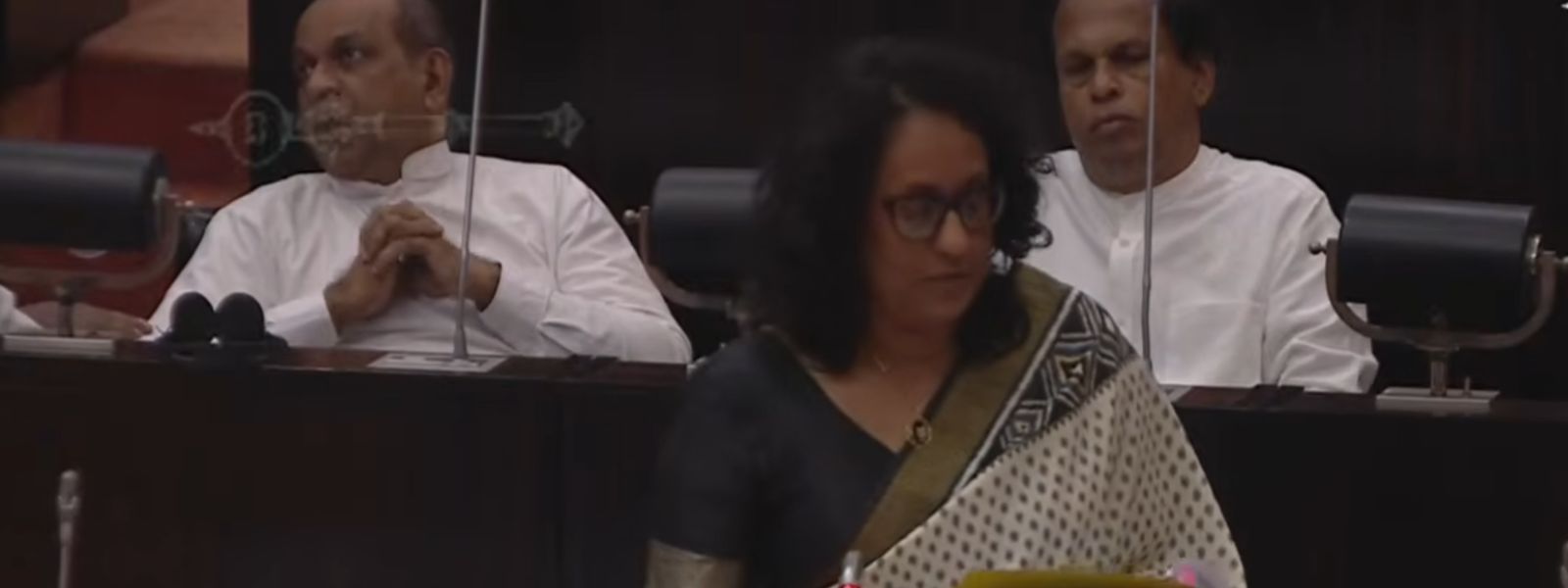
COLOMBO (News 1st); A national task force will be established to map all schools across Sri Lanka and determine educational divisions, zones and administrative boundaries covering every school in the country, Prime Minister Dr Harini Amarasuriya told Parliament today.
Addressing Parliament, the Prime Minister said the government is currently formulating a needs-based national resource allocation policy aimed at ensuring that children receive equal educational opportunities regardless of a school's location, student population, socio-economic background or administrative classification.
"Disparities continue to exist among schools across the country in the distribution of physical resources, infrastructure, teacher availability, technological facilities and learning opportunities. Therefore, a needs-based national resource allocation policy is being developed to ensure that educational opportunities available to children do not vary based on the location of a school, its student population, socio-economic background or administrative classification," she said.
The Prime Minister noted that policy recommendations on the minimum and maximum number of students that should be accommodated in a classroom have already been identified through policy documents including the concept paper on general education prepared by the National Education Commission and the National Curriculum Framework prepared by the National Institute of Education.
She said the General Education Sector Transformation Framework 2026-2032 has already been prepared and contains short-term, medium-term and long-term plans aimed at reducing inequalities within the school system.
According to the Prime Minister, the long-term strategy includes establishing a task force for the standardisation and strengthening of education divisions and zones, identifying infrastructure requirements, facilitating the sharing of resources among schools, enabling teacher transfers based on needs across divisions and introducing standard benchmarks for education divisions and zones.
She added that short-term measures focus on improving education quality by providing schools with direct allocations from provincial administrations and the central government, allowing institutions to address their own priority needs.
The government is also allocating funds for schools that have not yet achieved minimum sanitation standards, carrying out renovation work, and completing partially constructed school buildings, she said.
In addition, 335 schools are currently being upgraded under the Primary School Modernisation Programme.
The Prime Minister said plans are now underway to establish a national task force to map all schools across the island and define administrative boundaries for education divisions, education zones and related educational institutions.
Under the proposed framework, scientifically grounded measures will be considered for rural and estate schools with inadequate student populations.
She added that teacher allocations will continue to be made in proportion to the actual number of registered students in order to prevent teacher shortages and excesses, based on Circular No. 6/2021 issued by the Ministry of Education on determining academic staff requirements in schools.
The overarching objective, she said, is to guarantee equal educational opportunities for every student in every school across Sri Lanka.
"As a result, all strategies and activities contained in the framework have been designed to ensure fairness and equal opportunity within general education. We expect this approach to expand educational, digital, sports, arts, STEM and social learning opportunities for students in under-resourced schools, while narrowing the gap in experience and talent development opportunities between schools," Dr Harini Amarasuriya said.
Other Articles

-863144_550x300.jpg)





Featured News




News 1st, MTV Channel (Pvt) Ltd, MBC Networks (Pvt) Ltd, 45/3, Braybrooke Street, Colombo-02.
T.P : +94 114 792 700,
Fax : +94 114 792 733
T.P : +94 114 792 700,
Fax : +94 114 792 733




 |  |  |
|---|---|---|
 |  |  |
 |  |  |
 |

