.webp)


Debt Is Squeezing Human Rights Out of Public Budgets : UN



.png )
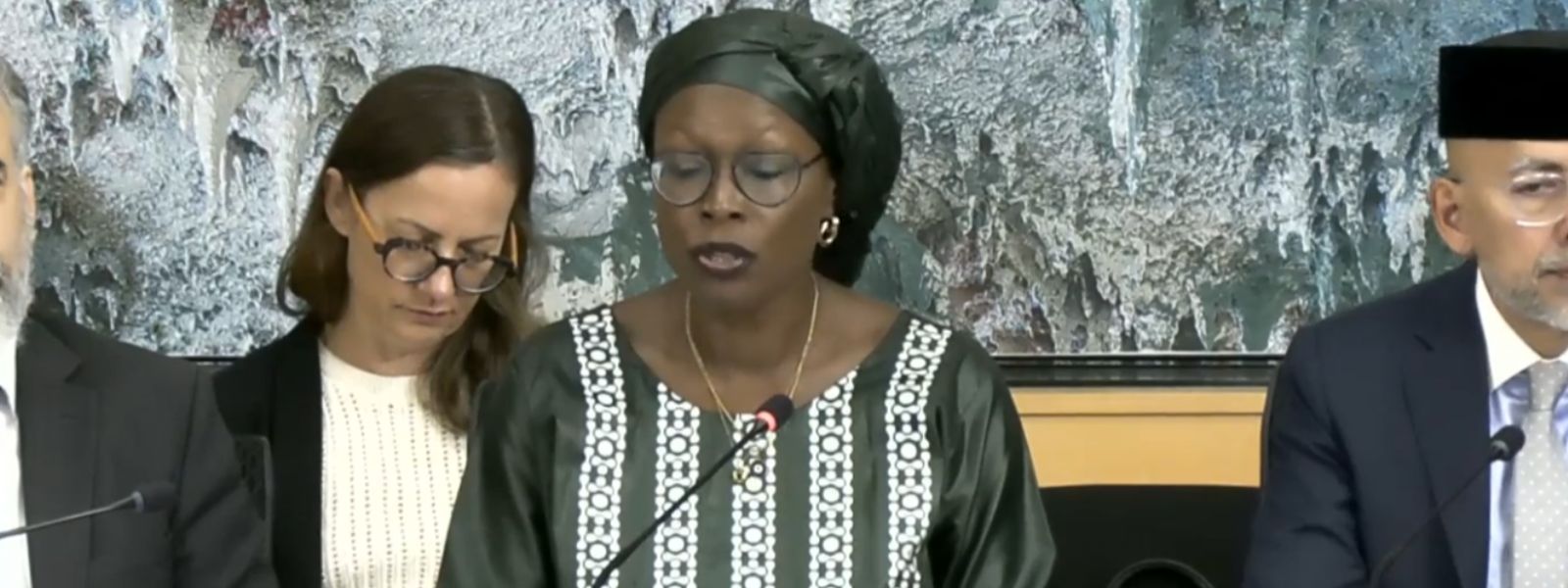
COLOMBO (News 1st); Mounting debt repayments and unequal global trade arrangements are continuing to squeeze human rights and human dignity out of public sector budgets, depriving millions of people of access to essential services, according to United Nations Deputy High Commissioner for Human Rights Awa Dabo.
Speaking on the 40th anniversary of the Declaration on the Right to Development, Dabo warned that despite global commitments made four decades ago, many countries remain trapped by financial and structural challenges that limit their ability to deliver meaningful development to their citizens.
"Development is a human right," she stressed, noting that countries formally recognized this principle when they adopted the Declaration on the Right to Development 40 years ago.
Dabo said the burden of debt continues to have far-reaching consequences for developing nations, forcing governments to divert scarce resources away from critical sectors such as healthcare, education and housing.
She warned that when countries are compelled to spend vast sums servicing debt instead of investing in hospitals, schools and public infrastructure, the damage can persist for generations.
The UN official also expressed concern over the sharp decline in international development assistance, revealing that global development aid budgets have fallen by nearly a quarter this year alone.
At the same time, she noted that arms sales by the world's largest defence companies have doubled in real terms over the past two decades, highlighting what she described as a troubling imbalance in global priorities.
Dabo further cautioned that climate change, pollution and biodiversity loss are accelerating a global crisis that poses the greatest threat to nations least equipped to respond.
According to her, these challenges are placing the right to development under increasing pressure, particularly in vulnerable developing countries that already face severe economic constraints.
She emphasized that the full participation of all people in development-related decision-making, as well as the fair distribution of development benefits, remains a central principle of the Declaration on the Right to Development.
These principles, she said, are closely linked to good governance, accountability and the creation of stable and prosperous societies.
Questioning whether the international community is living up to the commitments made four decades ago, Dabo called for a fairer and more inclusive global system, where all countries have an equal voice in decision-making processes and equitable access to financing.
She also urged governments and international institutions to strengthen development cooperation rather than weaken it, stressing that global support mechanisms are essential to helping developing countries overcome economic and social challenges.
In addition, Dabo called for international trade regulations to remain transparent, lawful and fair, and warned against the use of trade policies as instruments of coercion.
Other Articles

 1-855036_550x300.jpg)
-854969_550x300.jpg)




Featured News




News 1st, MTV Channel (Pvt) Ltd, MBC Networks (Pvt) Ltd, 45/3, Braybrooke Street, Colombo-02.
T.P : +94 114 792 700,
Fax : +94 114 792 733
T.P : +94 114 792 700,
Fax : +94 114 792 733




 |  |  |
|---|---|---|
 |  |  |
 |  |  |
 |

.gif)