.webp)


What Happened in Court Today? 22A Hearings Conclude



.png )
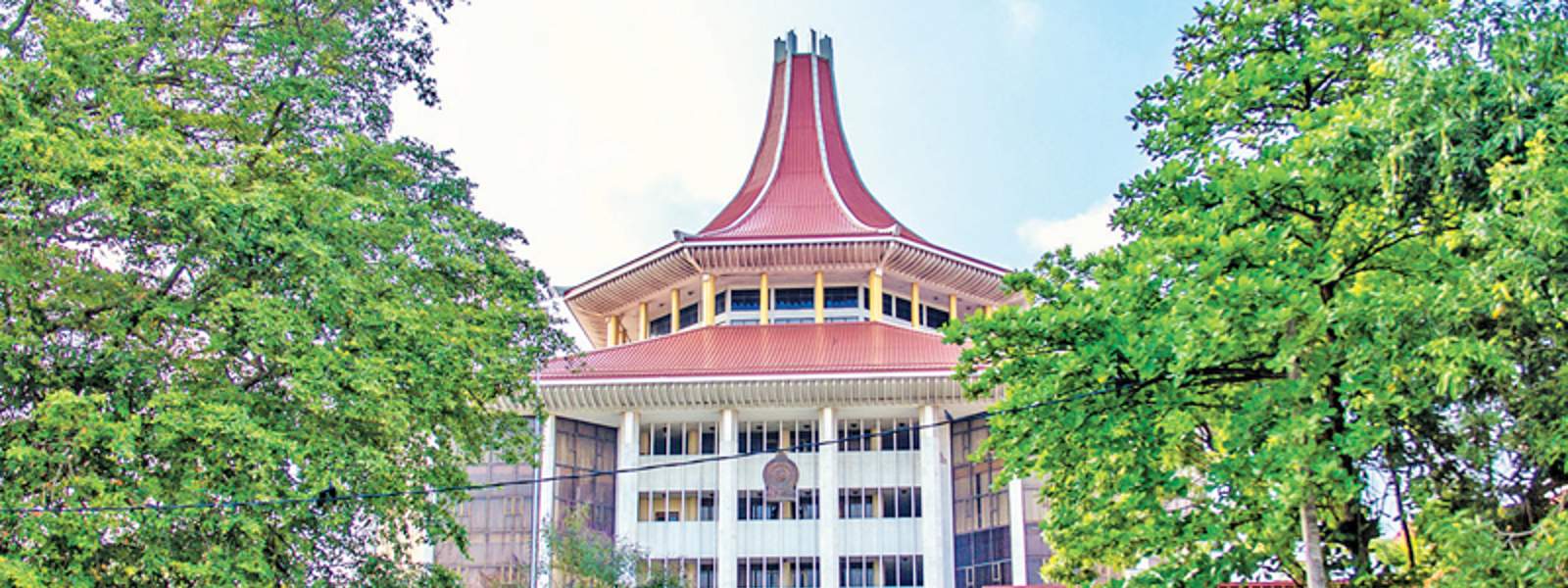
COLOMBO (News 1st); The Attorney General's Department told the Supreme Court that the Government had presented the proposed 22nd Amendment to the Constitution and the Judicature (Amendment) Bill with the objective of expanding and improving the efficiency of Sri Lanka's judicial system.
The submission was made by Solicitor General Viraj Dayaratne, appearing on behalf of the Attorney General, during the hearing of petitions challenging the proposed Bills.
The petitions were considered before a five-judge Supreme Court bench comprising Chief Justice Preethi Padman Surasena and Justices Achala Wengappuli, Arjuna Obeysekera, Sampath Abeykoon and Gihan Kulatunga.
Here's an extract of the submissions made in court by Solicitor General Viraj Dayaratne, Appearing for the Attorney General:
"Your Lordships, this proposed constitutional amendment reduces the powers of the Executive rather than increasing them. Although the petitioners have argued that the amendment violates Articles 3 and 4 of the Constitution, they have failed to legally demonstrate how such violations arise. If this proposed amendment affected the independence of the judiciary, the Government would accept that position. However, no such constitutional violation is created by this amendment. Furthermore, Your Lordships, when considering retirement age limits in other countries, judges of the United States Supreme Court are able to serve for life. In the United Kingdom, the retirement age was increased to 75, and retired judges were even recalled to service. Sri Lanka is not proposing such a measure. Historically, the retirement age of judges has always been higher than the retirement age applicable to the public service. At present, the retirement age in the public service is 60 years. Therefore, there is no issue with extending the retirement age of judges. The function of the Court is to determine whether these proposed Bills are consistent with the Constitution. It is only if they are found to be inconsistent with the Constitution that they may be referred to a referendum."
President's Counsel Nigel Hatch, appearing on behalf of petitioner and sitting Member of Parliament Lakshman Nipuna Arachchi, told Court that the proposed constitutional amendment did not require a referendum.
Here's an extract of the submissions made in court by President's Counsel Nigel Hatch:
"Your Lordships, the Bar Association of Sri Lanka and other petitioners argued that a referendum is required to pass this amendment. That position cannot be accepted. The petitioners do not refer to the 20th Amendment to the Constitution. Through that amendment, the number of judges of the Supreme Court and Court of Appeal was increased. It was not subjected to a referendum. If that was the case, how can increasing the retirement age of judges under the 22nd Amendment become a constitutional issue? The 1972 Constitution fixed the retirement age of judges at 63 years. The 1978 Constitution subsequently increased it to 65 years. The proposed Bill does not violate Article 3 of the Constitution. Nor does it undermine the independence of the judiciary. No constitutional provision is being diminished. Therefore, a referendum is not required for the passage of this Bill, Your Lordships."
President's Counsel Mohan Weerakoon, appearing on behalf of an intervening petitioner, Nawa Sihala Urumaya Party leader Sarath Manamendra, submitted that increasing the retirement age of judges would not compromise judicial independence.
Here's an extract of the submissions made in court by President's Counsel Mohan Weerakoon:
"Your Lordships, when one considers population growth and increased life expectancy in Sri Lanka, this can be regarded as a timely amendment. In 1948, average life expectancy ranged between 48 and 55 years. By 1978, it had increased to between 67 and 69 years. Today, life expectancy has risen to approximately 77 years for men and 81 years for women. Given this increase in life expectancy, raising the retirement age of judges is both timely and reasonable. In the United Kingdom, the retirement age of judges was increased from 70 to 75 through a simple parliamentary majority. No referendum was conducted. Accordingly, the present amendment does not violate any constitutional provision and does not require approval through a referendum."
Attorney-at-Law G.G. Arulpragasam, appearing on behalf of another intervening petitioner, also made submissions to the court.
Here's an extract of the submissions made in court by Attorney-at-Law Niranjan Arulpragasam:
"Your Lordships, many petitions have alleged that the proposed amendment undermines the independence of the judiciary. That argument cannot be accepted. Increasing the retirement age of judges is not an arbitrary measure. In the United States, judges may serve for life. In the United Kingdom and Canada, the retirement age of judges is 75 years. In addition, countries such as Australia, New Zealand, South Africa and Jamaica prescribe a retirement age of 70 years. Accordingly, increasing the retirement age of judges does not require a referendum."
Following the conclusion of submissions, the bench directed petitioners to file their reply submissions before 3.00 p.m. tomorrow.
Thereafter, Chief Justice Preethi Padman Surasena announced that the Supreme Court's confidential determination on the petitions would be communicated to the Speaker of Parliament in due course.
Other Articles




-853486_550x300.jpg)




Featured News


-849213_550x300.jpg)

News 1st, MTV Channel (Pvt) Ltd, MBC Networks (Pvt) Ltd, 45/3, Braybrooke Street, Colombo-02.
T.P : +94 114 792 700,
Fax : +94 114 792 733
T.P : +94 114 792 700,
Fax : +94 114 792 733




 |  |  |
|---|---|---|
 |  |  |
 |  |  |
 |

.gif)