.webp)


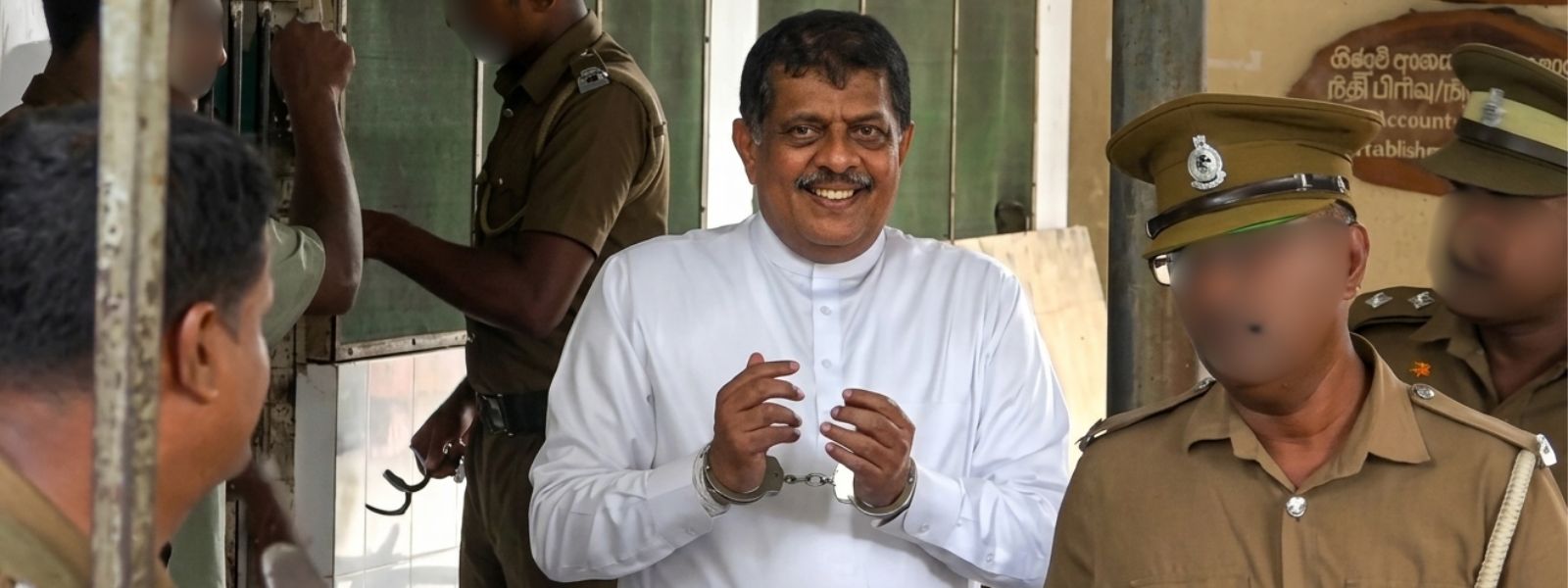
'Economic Decline Fueled by Corrupt Officials,' says Judge In Sarana Gunawardena Sentencing



.png )
COLOMBO (News 1st); Former Deputy Minister Sarana Gunawardena, who was found guilty of corruption charges, was today sentenced to 16 years of rigorous imprisonment by the Colombo High Court.
The trial judge, delivering verdicts in four separate cases against the accused, imposed a total sentence of 72 years, which is to be served concurrently, resulting in an effective prison term of 16 years.
In addition, Sarana Gunawardena has been ordered to pay a fine of Rs. 1.8 million in connection with the four cases.
The Bribery Commission had filed four cases against Sarana Gunawardena, alleging that while serving as Chairman of the Development Lotteries Board in 2006, he committed the offence of “corruption” by causing a financial loss to the government through the procurement of vehicles on a rental basis for the institution.
Charges were filed against the accused under Section 70 of the Bribery Act No. 1954 of 2022, on counts of corruption across the four cases.
Delivering the verdict in the first case, the High Court Judge stated that the charges brought against the accused had been proven beyond reasonable doubt and accordingly found him guilty.
“The accused, on three separate occasions, authorized advance payments of Rs. 1.56 million, Rs. 1.521 million, and Rs. 960,000 using funds of the Development Lotteries Board, with the intention of conferring an undue benefit to an external party. As a result of these actions, a financial loss has also been caused to the government,” said High Court Judge Mihail.
Counsel appearing for Sarana Gunawardena, Attorney-at-Law Ranjan Silva, requested the court to consider imposing a lenient sentence under Section 303 of the Code of Criminal Procedure Act.
“I request that a lenient sentence be considered. The accused is 62 years old. He is a heart patient and also suffers from diabetes. He has no intention of returning to politics and is currently engaged in business activities.”
Appearing for the Bribery Commission, Assistant Director General Asitha Anthony urged the court to impose a sentence that would serve as a strong deterrent and a message to society.
“My Lord, this is an offence related to corruption. Corrupt practices by public officials have contributed to the economic decline and even the bankruptcy our country has experienced in recent times. As a result, people were forced to wait in gas queues and fuel queues. Public officials entrusted with public funds have a duty to safeguard those resources. However, the accused has influenced other officials to engage in corrupt practices. The actions of a small group can have devastating consequences for an entire nation. Therefore, I request that a sentence be imposed that sets an example for all public officials.”
Considering the submissions, the trial judge emphasized that the court does not find it appropriate to impose a lenient sentence under Section 303, given the seriousness of the offence and the fact that the accused has been found guilty.
“Corruption committed by public officials within state institutions has contributed to the economic decline of this country. Such actions have eroded public trust in government institutions. In this context, it is not possible to grant leniency to the accused. Considering the nature of the offences, the court is of the view that a sentence must be imposed that will deter corruption within state institutions. Accordingly, in the first case against the accused, I impose a sentence of four years’ imprisonment for each of the six charges, to run concurrently. In addition, a fine of Rs. 100,000 per charge, totaling Rs. 600,000, is also imposed.”
The remaining three cases filed by the Bribery Commission against Sarana Gunawardena were based on similar allegations.
Accordingly, the judge delivered verdicts in those cases as well, convicting the accused and imposing sentences.
Following the court’s ruling, Sarana Gunawardena was taken to the Welikada Prison this afternoon to begin serving his sentence.
Other Articles








Featured News


-835300_550x300.jpg)

News 1st, MTV Channel (Pvt) Ltd, MBC Networks (Pvt) Ltd, 45/3, Braybrooke Street, Colombo-02.
T.P : +94 114 792 700,
Fax : +94 114 792 733
T.P : +94 114 792 700,
Fax : +94 114 792 733




 |  |  |
|---|---|---|
 |  |  |
 |  |  |
 |

.gif)