.webp)


Global War Becomes Humanity’s Top Fear, UN Survey Reveals



.png )
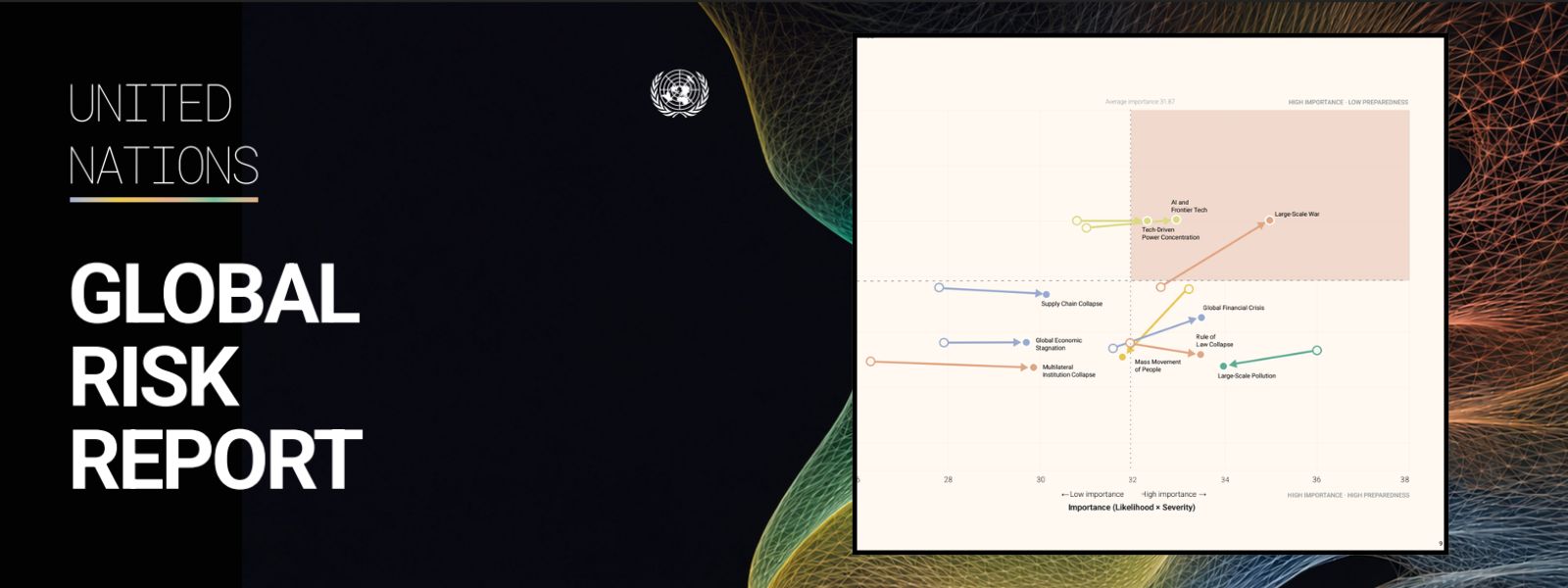
COLOMBO (News 1st); Two years ago, the prospect of a large-scale global conflict was viewed as a distant possibility. Today, it has become the world's biggest concern, according to a new United Nations Global Risk Report that identifies major war as the most significant threat facing humanity.
The report, released by the UN on September 15, is based on the views of approximately 1,300 participants drawn from governments, international organizations, academia, civil society and the private sector across every region of the world. Respondents assessed 28 major political, economic, environmental, societal and technological threats based on their likelihood, potential impact and the world's ability to respond.
According to the findings, the risk of large-scale war recorded the sharpest increase of any threat since 2024, climbing 16 places in the rankings. More than a third of those surveyed, 36 per cent, believe the effects of a major war could impact a significant portion of humanity within the next year, while 76 per cent believe such consequences could materialize within seven years. The report also found that large-scale war was the only threat to rank among the top six across all key indicators measured, including importance, urgency, interconnectedness with other risks and the lack of preparedness among institutions tasked with responding.
UN Secretary-General António Guterres, writing in the report's foreword, described the findings as sobering, noting that political risks have moved to the centre of global concerns. He warned that the prospect of large-scale war is viewed as far more immediate and dangerous than it was only two years ago, while confidence in the institutions expected to manage such crises has weakened significantly.
The report highlights a dramatic shift in global perceptions. While environmental threats, misinformation and pandemics dominated major risk discussions in previous years, geopolitical tensions, armed conflict and a weakening rule of law now occupy the forefront of international concern. Large-scale war and geopolitical tensions rank among the ten most serious threats in every region covered by the survey and feature among the top five concerns in six of the seven regions examined.
Concerns over weapons of mass destruction have also intensified, particularly in Central and Southern Asia, Sub-Saharan Africa and Oceania. In East and Southeast Asia, respondents identified a potential global financial crisis, artificial intelligence-related risks and the growing influence of major technology companies among their leading concerns. Similar anxieties surrounding artificial intelligence have emerged among respondents in Europe and North America.
The report emphasizes that global risks do not exist in isolation. It warns that resource shortages, economic fragmentation, disinformation campaigns and weakening international institutions all contribute to rising geopolitical tensions, which in turn increase the likelihood of major conflict. Researchers found the strongest link among all identified risk connections to be the relationship between geopolitical tensions and large-scale war.
Artificial intelligence also emerged as a growing concern. The report notes a sharp increase in fears related to AI, emerging technologies and the concentration of technological power, at a time when respondents believe the international system is least prepared to address such threats. Nevertheless, climate change remains a major concern, with inaction on climate change continuing to be rated as the single most important risk overall and featuring prominently across all regions.
The survey also identified weak governance, declining trust, poor coordination and a lack of political consensus as major obstacles preventing effective risk management. An overwhelming 86 per cent of respondents said current funding dedicated to reducing global risks is insufficient, particularly in areas related to natural disasters and the potential collapse of multilateral institutions.
While the UN stresses that the report represents a snapshot of expert perceptions rather than a prediction of future events, it underscores a clear message: the international community increasingly sees cooperation between governments as the most effective way to prevent catastrophe.
The UN is careful to frame the report as a snapshot of perceptions rather than a prediction. Respondents still see joint action between governments as by far the most effective means of prevention. No country, no company, no institution can face these risks alone.
“The 2026 Global Risk Report sets out the evidence that must inform our choices. We owe it to present and future generations to use this knowledge wisely, and to act while cooperation can still shape a safer course.
“The choice is ours,” the Secretary-General said.
Other Articles
-855330_550x300.jpg)

-855287_550x300.jpg)
-855280_550x300.jpg)




Featured News




News 1st, MTV Channel (Pvt) Ltd, MBC Networks (Pvt) Ltd, 45/3, Braybrooke Street, Colombo-02.
T.P : +94 114 792 700,
Fax : +94 114 792 733
T.P : +94 114 792 700,
Fax : +94 114 792 733




 |  |  |
|---|---|---|
 |  |  |
 |  |  |
 |

.gif)