.webp)


-847152.jpg)
Medical Renaissance? Sri Lanka’s First AI-Enabled Surgery



.png )
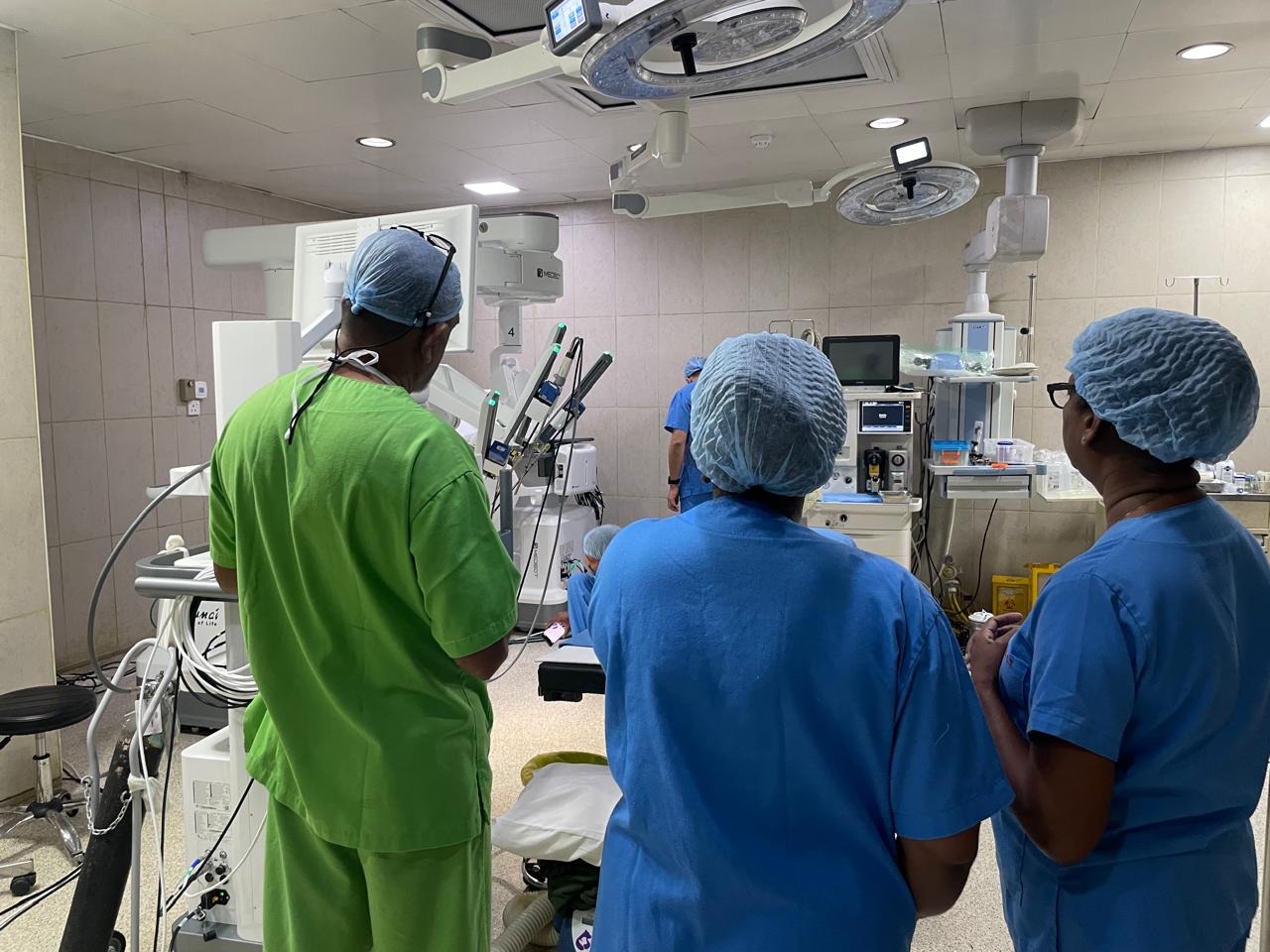
COLOMBO (News 1st): Can you imagine a robotic arm digging around your guts? Well, two days ago, that became a reality. On Tuesday (14th July), AI-enabled surgery happened for the first time in Sri Lanka. Twice, in fact.
The first consisted of a hysterectomy (removal of the uterus) on a 50-year-old patient, and the second a complex kidney procedure. Both high-risk procedures which can now be performed with the lowest risk rate yet.
Specifically, both are classified as ‘deep pelvic surgeries.’ This class of surgery, as stated by Dr. Harry Prasad (Director of Operations at the private hospital in which the historic surgeries took place), stands to gain the most from the introduction of AI-enabled and robotic-assisted technology.
“Because the chances of you going wrong there or injuring some vessel inside is very high,” he states. Indeed, the deep pelvis contains both very significant blood vessels (at risk of extreme blood loss if damaged), main neurological pathways, and sensitive reproductive organs--to name a few.
“Above 60 years [old], almost every other man will have [..] an enlargement of the prostate.” Typically, the traditional surgical method to remove the prostate carries the high risk of damaging a nerve, or causing erectile disfunction. This causes many to either forgo surgery even at risk of the condition worsening (even becoming cancerous), or seeking surgery abroad, most often from India.
“Almost all these robotic deep-pelvic surgeries--the success rates are above 99%,” Dr. Harry affirmed.
Many may wonder: if the surgeon is good enough, why is a ‘robot’ even needed? However, AI-enabled surgery is not only prized for being a technical advancement, but rather as unlocking an entirely new standard for surgery. If you, too, were in the operating theatre observing the new machine, you would remark on how tiny the tools are: a humming machine the size of a double-door fridge, but scalpels and forceps the size of a fairy’s tweezers.
This dramatically reduced instrument size means smaller incisions and less cuts in general. Less wounds to heal afterwards, thus speedy recovery, no need for major drains jammed into the operating site, and less blood loss. “You don’t need to stay for 5 days in the hospital,” Dr. Harry stated, “you do surgery…in the morning--by same day in the evening, you are discharged.” One of the aforementioned patients from the novel surgeries “might even be discharged tomorrow.”
But what about the cost? The accessibility of the novel procedure has been the main point of questioning.
Keep in mind: whenever new technology is purchased, costs will inevitably be higher until the investment is paid off. The new MedBot model is “almost 3 times more expensive,” involving an investment by the clinic of around Rs. 150 million -- variable to currency exchange rates. However, no one will pay millions for a surgery. Thus, Dr. Harry admits, the current expenditure is “not very lucrative for [the hospital],” but they vow to “keep pricing at a nominal level.”
Interestingly, the main factor which racks up the price of such procedures is not the initial purchasing cost, but rather a ‘locking’ mechanism programmed into the machines. DaVinci instruments--for example--will ‘lock’ after only 8 surgical uses, requiring new machines to be purchased, up to “4 to 6 machines for one [high risk] patient,” incurring tremendous cost to the clinic. The reason for such a mechanism--aside, of course, from planned obsolescence to increase profit--is to prevent abuse of the technology.
“Otherwise, one person might do that for 200, maybe 150 surgeries [to the point that the tool] might not even be cutting.” Here, he refers to the increasing dullness of the tiny blades. As such, though the system seems needlessly costly, it acts as a checks-and-balances mechanism to protect the patient.
Looking towards the future, as more such machines are brought to Sri Lanka, introducing more competition both between medical providers and medical technology conglomerates, the price will inevitably reduce. “Most laparoscopic procedures [involving controlled, minor incisions] will be robotic-assisted in the next several years,” he predicts.
“We have looked at it as a responsibility towards Sri Lankans,” states Dr. Harry. Indeed, this milestone brings a treasure trove of benefits to the nation. For one, the increasing sophistication of Sri Lankan healthcare will stem the brain-drain of our medical professionals to the West. Already, the private hospital has trained 10 in the technology, and plans to train innumerably more. Calls have been ringing in of bright doctors from Colombo to Jaffna, desperate to be trained in the technology--to be a part of Sri Lanka’s medical renaissance.
Equally, those who--as previously stated--would opt for a procedure abroad are reined within the Sri Lankan healthcare system, driving the economy, lending more experience to doctors here, and improving accessibility for those who cannot afford to fly overseas for a life-saving procedure.
As Sri Lanka’s population lives longer--with 25% in 2040 predicted to be over 60--efficient and sophisticated healthcare systems are a crucial element in the nation’s future to tackle the associated increase in chronic diseases such as cancer, diabetes, and heart disease.
“The greatest barrier is perception,” Dr. Harry admits.
Several online have voiced concerns over a robot operating on them. C3PO in the operating theatre is called to mind. This is a gross misconception of the technology. “AI-enabled robotic-assisted” is the official means to describe the practice. The Doctor compared it to “video games” or “Nintendo”: you have two joysticks, controlled by you and only you. You are operating through a robotic device--it is not a robot making the decisions.
“You’re not just giving a command. It’s not a robot doing surgery. It’s a robot assistant”
Again, when AI is mentioned, many may immediately think of a medical ChatGPT diagnosing their illness and taking it upon itself to remove a tumor. And again, this is false. An example of ‘AI involvement’ in the surgery is to warn the surgeon: the surgeon pinches a blood vessel between the instrument’s forceps to clamp it. If they hold down too hard, a bright red screen bursts into their field of view: ‘Warning: Risk of Rupture.’
In fact, AI-enabled surgery dramatically improves the performance of individual surgeons. A surgery that, previously, would “take 7-8 hours,” can now be done in “one or two.” A single surgeon can perform many more surgeries per day--reducing waiting lists, and addressing conditions before they reach dire stages. During surgery as well, the doctor is seated comfortably rather than upright and standing for 8 hours, allowing doctors to preserve their stamina, thereby maintaining premium mental clarity and confidence in their actions all day long. This further reduces burnout in medical professionals.
Rather than stealing jobs, AI-enabled systems in healthcare will help medical professionals do their job better, more comfortably, and gain greater reach.
While future advancements could involve a greater role of AI, medical professionals are still gravely needed. AI systems can only progress so far if they are in constant and continuous contact with medical professionals: every surgery performed with an AI-enabled system will enrich its memory, rippling forward until the quality of medical care increases exponentially for the next surgery.
“There is no reason for doctors to get challenged, but then again, they have to get involved and learn the system.”
Trust is also significant. After all, Tuesday’s surgeries required a tremendous amount of trust from the patients. It is a frightening concept to be the first test subject for a new technology when your life is on the line.
That trust, Dr. Harry stated, came not just from trusting in a technology most were not even aware of, but in trusting their doctor. Because the patients had faith in and a genuine human relationship with their doctor, the concept of the Doctor working through a machine was no longer imposing.
“Because at the end of a day, you go to a specific doctor, not just because he’s really good. It’s about that empathy and how he approaches you: the consent, that human touch. I don’t think as a human, you will let go of that.”
This is not groundbreakingly new technology. It has been in use since the 2010s--long enough to hammer out any minor errors, inconsistencies, and to perfect the global practice. But that’s not the important part. The important part is that this is the first time it has ever been used in Sri Lanka.
Hope is what this news brings. Hope for advancements in our health, and to leave Sri Lanka with a little less pain than before.
An Article By Clement Deane
Other Articles










Featured News




News 1st, MTV Channel (Pvt) Ltd, MBC Networks (Pvt) Ltd, 45/3, Braybrooke Street, Colombo-02.
T.P : +94 114 792 700,
Fax : +94 114 792 733
T.P : +94 114 792 700,
Fax : +94 114 792 733




 |  |  |
|---|---|---|
 |  |  |
 |  |  |
 |

.gif)