.webp)


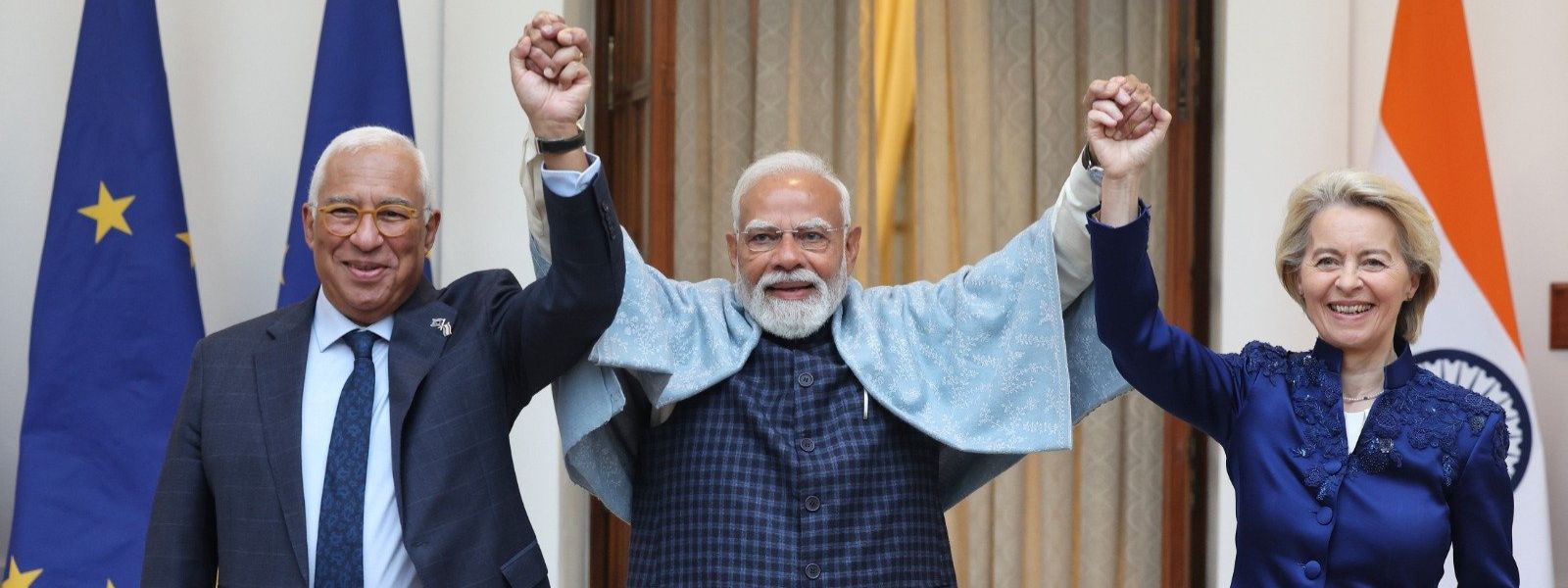
€4 Billion in Annual Savings & 96% Tariff Cuts : EU–India Free Trade Agreement Sealed



.png )
COLOMBO (News 1st); A major shift in global and regional trade dynamics has taken place with the conclusion of the European Union–India Free Trade Agreement (FTA) on 27 January 2026, marking the end of negotiations that were formally relaunched nearly four years ago.
On 17 June 2022, the European Union reopened negotiations with India for a comprehensive Free Trade Agreement, while simultaneously launching separate negotiations for an Investment Protection Agreement and an Agreement on Geographical Indications (GIs).
After years of intensive engagement, discussions on the Free Trade Agreement have now reached a successful conclusion, setting the stage for transformative economic cooperation between one of the world’s largest economic unions and its most populous nation.
What the Free Trade Agreement Delivers:
At its core, the EU-India Free Trade Agreement offers privileged access for European exporters to India’s vast market of 1.45 billion people, the largest population in the world.
The agreement is expected to potentially double EU goods exports to India by 2032, fundamentally reshaping trade flows between the two partners.
A central feature of the deal is the elimination or reduction of tariffs on more than 96 percent of EU goods exports to India.
This includes the removal or lowering of previously prohibitive tariffs on key European agri-food products, such as:
Wine, Olive oil, Chocolate, Pastries.
Collectively, these tariff concessions are projected to save approximately €4 billion every year in duties on European products, enhancing competitiveness for EU exporters and increasing product choice for Indian consumers.
Alongside the FTA, negotiations continue on a dedicated Investment Protection Agreement, designed to create a predictable, secure, and balanced investment environment for investors on both sides.
These negotiations focus on commitments related to:
Non-discrimination of investors, Protection against expropriation without compensation and unfair treatment, while preserving each side’s right to regulate, Free transfer of investment returns
In addition, the agreement seeks to establish a state-of-the-art dispute settlement mechanism, ensuring that investment rules are enforceable and transparent, an important signal for long-term investors operating across borders.
Other Articles
-824772_550x300.png)
-824766_550x300.png)
-824760_550x300.jpg)






Featured News
-822734_550x300.jpg)
-822716_550x300.jpg)
-822495_550x300.jpg)
-819380_550x300.jpg)
News 1st, MTV Channel (Pvt) Ltd, MBC Networks (Pvt) Ltd, 45/3, Braybrooke Street, Colombo-02.
T.P : +94 114 792 700,
Fax : +94 114 792 733
T.P : +94 114 792 700,
Fax : +94 114 792 733




 |  |  |
|---|---|---|
 |  |  |
 |  |  |
 |

.gif)